Thursday, May 29, 2014

Review: Red Rising


15839976
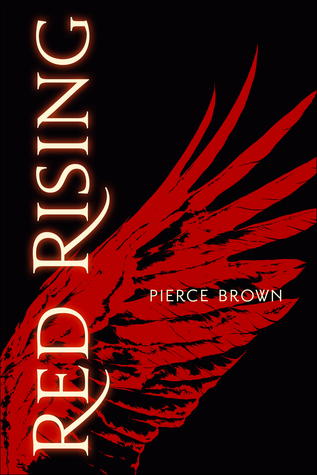
Red Rising by Pierce Brown
Book one of the Red Rising Trilogy
Release Date: Jan 2014

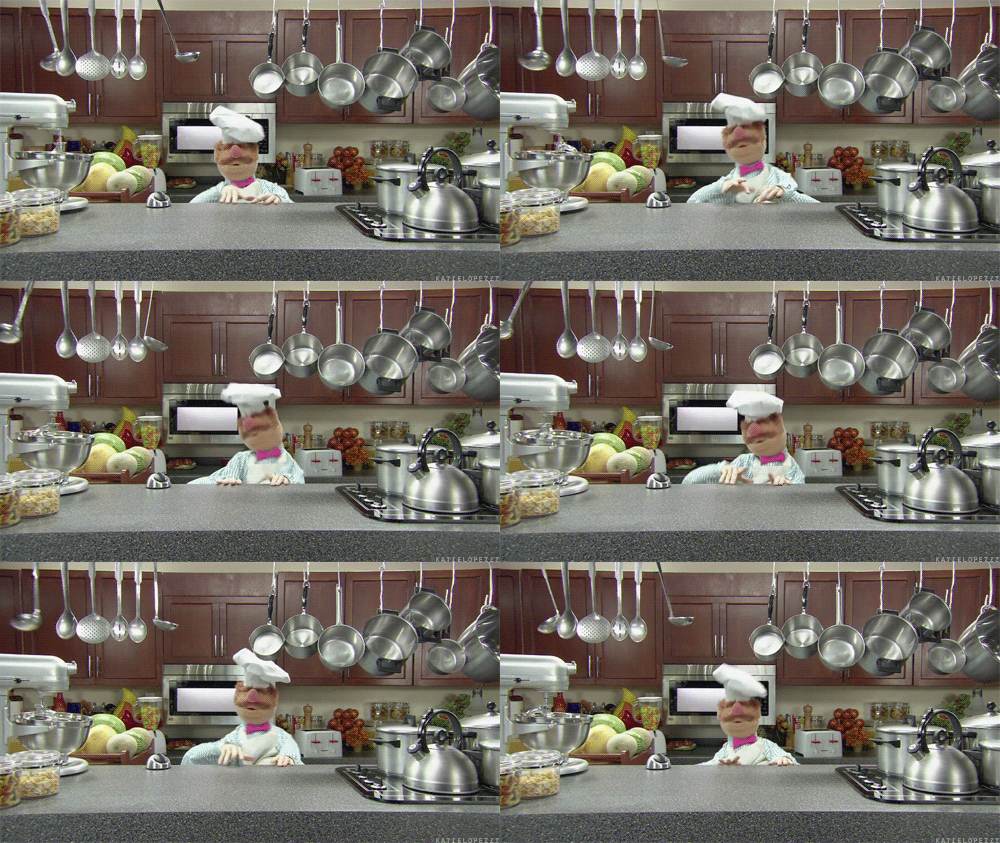
Hello kids!
Let's get into the writing kitchen and write a Pretty Decent Book!
 Here's the recipe (as far as I can tell) for Red Rising:

Begin with a base of two parts City of Ember and one part the first chapter of The Hunger Games.
Let setting be "on Mars" for flavor, liberally using air quotes.
Include totally-see-it-coming injustice.  Toss well.
In a separate scene/bowl, shake a little of Uglies with the "makeover" parts from Hunger Games/Catching Fire.  
 Once mixture has reached desired tension, add the following:
  • Greek mythology references from Percy Jackson series
  • Attribute-based housing from Harry Potter and Percy Jackson
  • Brutal, allegedly supervised arena fights from Hunger Games/Catching Fire/Battle Royale
  • Complete batshit insanity, violence and social decay from Lord of the Flies
  • Downtrodden underdog becoming unlikely lord of death with his small-yet-feisty band from Dune - and pretty much every "hero's journey" story ever
Allow mixture to heat until it boils over.  And makes a very exciting mess.

For all the books that are rolled into this one, there should be something for almost every reader.  It's not a revolutionary new tale, but neither was The Hunger Games (purists will defend Battle Royale to the end, I guess), and that series did well enough for itself. There is enough drama and violence to sate almost any appetite, and enough power plays, survival dramas and political machinations to engage the mind.  Both young adult and adult audiences should find something in these pages.

I certainly enjoyed the book.  While I finished it a few weeks ago and have already forgotten the hero's name, the excitement of the story is still sticking with me.

Will I read the sequel?  Yeah, probably...when it's released.  Next year.  In fact, if you want to read this book, I might wait a bit so you don't have to do the Recollection Re-read.

4 stars for the engaging nature of the story.  3 stars if you're looking for a more original novel.

Monday, May 19, 2014

The Lost Fleet: Dauntless by Jack Campbell


The Lost Fleet: Dauntless by Jack Campbell
Book 1 of The Lost Fleet

The Alliance has been fighting the Syndic for a century-and losing badly. Now its fleet is crippled and stranded in enemy territory. Their only hope is Captain John "Black Jack" Geary-a man who's emerged from a century-long hibernation to find he has been heroically idealized beyond belief. Now, he must live up to his own legend.

Review:
Just as Fantasy has many subgenres (high, epic, dark, urban, historical, etc), so does Science Fiction have its subgenres: speculative, dystopian/post-apocalyptic, space opera, alternate history, to name a few.  One of the currently popular genres is "military science fiction" - which I sincerely hope needs no explanation.

The blurb on the back of the book is about as much setup as you need for this story.  A soldier has awakened from a century of cryogenic sleep to find the war that he almost died in is still raging on, that his fleet is in danger, and that he might be the only one that can rescue the Alliance fleet from a dilemma of their own making.  Bam.  Action.

Campbell doesn't pull any punches with getting the action started.  In fact, the whole book reminded me (favorably) of the early episodes of Battlestar: Galactica, in which thousands of lives are at stake and there is no time for careful contemplation.  Geary makes a decent protagonist, if not exactly a ground-breaking one (another white male soldier/space marine, anyone?), and his core decency gives the book a moral core, while his impatience and frustration with the decayed discipline among his fellows gives the book some emotional drive.

One thing that science fiction has traditionally excelled in is being rather egalatarian about gender and race issues, from Uhura on Star Trek to Lady Jessica in the Dune series.  While Campbell plays it safe with the race and gender or his protagonist, he isn't hidebound into forcing an all-white, all-male cast.  Two characters Geary brushes against regularly are female: a ship's captain and a civilian co-president.  The fact that the author was willing to place two women in places of authority - authority "Black Jack" Geary never questions - was good enough that I won't be too disappointed that the rest of the cast seems to have a Y chromosome.  Better than nothing.

The plot of the book reads like the pilot episode of a new smash-bang sci-fi roller coaster, with death and danger around every corner, followed by political machinations and power plays in rapid succession.  Adventure!  Schemes!  Heroes/heroines!  Sacrifice!  Excitement!

And since this feels like a pilot episode, absolutely nothing is resolved - not that it should be.  The initial encounter is teed up and the whole dramatic arc is plotted in front of you:  Will Geary be able to get the fleet home?  How many will survive?  What other adventures wait for our fleet before the end?

Not exactly the deepest book every written, but not disappointing, either.  If you're looking for a by-the-numbers military fantasy, then this is a solid book to pick up.  At 293 pages, it won't be a heavy read by any definition of the phrase.
 
3.5 stars!
Will I read the sequels?
Oh, yes.  Mm-hmm.  Yep.
PEW PEW PEW!

Wednesday, May 14, 2014

Gateway Books: When a Single Read Becomes a New Obsession

We've all heard of them.  You think "oh, I'll just try it once; it'll be no big deal."  But then one things leads to another and suddenly you're trying to convince yourself you don't need to buy food this week because you need your next hit.

That's right, people.  I'm talking about Book Addiction.
It starts out so innocuously:  just one little book, sitting so peacefully on a shelf, looking so harmless.  And then you have to have another.  And another.  And then you can discuss the merits of the classics and are greeted by first name when you enter the library or the bookstore.

It can happen to any of us, folks. 

The scariest parts of Book Addiction are those Gateway Books.  The ones that make you rethink your answer to the question "what do you read, mostly?"  Formerly you never would have thought that you were a reader of Science Fiction, but now you can describe in detail why it's such a big deal that Episode VII isn't going to use the expanded universe as canon. 

Here are the books that introduced me to various genres throughout my life.

Mythology
As a young child, I read pretty much anything.  However, the first book that I remember fanning an obsession was The Gorgon's Head.  It had been sitting on a burgeoning bookshelf at my grandparents' house and I picked it up because of the picture on the cover.
I remember it looking so much cooler than this...
I remember tearing through this book and then through all of the children's books on Greek mythology...and then even into the adult non-fiction section.  Ah the 293.2 section...  Bless you, Dewey Decimal System!  I read so many books on the subject that when I took a class on Greek Mythology in college, I was one of two people in the class to score more than 100%.  No-so-coincidentally, the other over achiever was another girl who had fallen in love with these stories as a child.  As an aside, she was from Sparta, Wisconsin.  I didn't even have to make that up.


Fantasy
Ah, the tweens.  Such awkward years.  Fortunately for me, my forays into the adult shelves at the library led me to the SF/F racks, where I found a brand-new, shiny copy of Arrows of the Queen.  I know this book has some flaws, but I still get warm fuzzies when I re-read it.  Yes, the dialogue can be awkward and clunky, and yes, the plot is pretty obvious, and yes, the protagonist can be a Mary Sue but I DON'T CARE.  I love it and you'll never convince me it's a bad book. 
Horses and pink and purple and heroines and friendship and magic and OMG I LOVE THIS BOOK.
Arrows was soon followed by Piers Anthony's Demons Don't Dream.  This was the book that showed me that fantasy doesn't have to be serious all the time.  This books has video games and puns and fake Florida and puns and magic and puns...basically it's 360 pages of puns.  After realizing that this was only an installment in a larger series, I went back to the beginning of the series and read a whole bunch of them.
Did I mention the puns?

Dangerous stuff, here, people,  Tell your kids about the dangers of fun fantasy books.

Historical Fiction
I remember reading Clan of the Cave Bear in middle school, but no matter how much I loved that series, it never really kicked off a love of HF in general.  At the time, I'm not even sure I knew that was a thing.
Years later I would see The Other Boleyn Girl all over the place.  I didn't even want to read it.  Who would want to read about that horrible king who killed his wives?  Why would you want to read about Anne Boleyn?
...But I did.
And I was hooked.  I barreled through several of Philippa Gregory's other works before casting a wider net.  I don't read as much HF as I used to, but it's still a major player on my shelves. 
Putting the "fiction" in "historical fiction" for over ten years now!
The Classics
Had it not been for a couple girls I met when studying abroad, I might never have discovered that classics can actually be good books - and not just for people who want to look smart!
Pride and Prejudice was pushed into my hands and I reluctantly read it.
*Swoon*
After that, it was a slippery slope to falling into Dickens (which, I admit, I have partially introduced myself to through BBC's miniseries), the Brontes, Tolstoy, Trollope, Gaskell and others.
The classics, man.  They're not just for boring literature classes!

Science Fiction
Yes, I read Ender's Game in college.  Yes, I enjoyed it.  But it didn't trigger the "I must read more of what this genre has to offer" reaction that a true Gateway Book will.
Yes, dystopian and post-apocalyptic fiction technically fall under the Science Fiction umbrella.  (Hello, Hunger Games!)
The real "What else have I been missing" moment came late last year when I read Fortune's Pawn by Rachel Bach (aka Rachel Aaron).  From the tough-yet-feeling heroine (in her giant suit of space armor) to the adventure (in spaceships!) to men possessed by aliens (from outer space!) to invisible space monsters (in...um...space!), this book made me desperately want to start cramming ALL THE SPACE OPERA into my face. 
Read this book...in SPAAAACE.

Undiscovered Genres
If a book's premise sounds good, I will generally read anything once.  However, there are many genres that I feel comfortable saying "I don't really read that" because I have yet to have a really good hit of a Gateway Book from one of them.
  • Mystery.  This isn't to say that I haven't read a mystery book, or that I don't like mystery in my books. I just don't spend any time in the mystery shelves of my library or bookstores.  
  • Westerns.  My grandfather loved westerns the way I love fantasy or historical fiction.  I've just never really gotten into it.  I see the allure; it's just not for me.
  • Poetry. I have a tin ear for poetry.  I don't know or understand what makes poetry "good."
  • Biographies.  I love the idea of biographies, but with few exceptions I don't seek them out.
  • Steampunk.  Ah, the aesthetic without a purpose.  So many of the Steampunk books I've read are so similar it's hard to distinguish them from one another.  It's like this sub-genre is looking for a revolutionary to give it a direction.   
  • Horror.   In a way, I feel like Horror and Fantasy are cousins.  However, I generally enjoy sleeping at night and not being afraid of my own shadow.
 Any pointers for my next Gateway Book?  What were yours?


Monday, May 12, 2014

Review: The Winter Witch by Paula Brackston


In her small early nineteenth century Welsh town, there is no one quite like Morgana, who has not spoken since she was a young girl. Her silence is a mystery, as well as her magic.  Concerned for her safety, her mother is anxious to see her married, and Cai Jenkins, a widower from the far hills, seems the best choice.
 After her wedding, Morgana is heartbroken at leaving her mother, and wary of this man, whom she does not know, and who will take her away to begin a new life.  But she soon falls in love with Cai’s farm and the wild mountains that surround it. Cai works to understand the beautiful, half-tamed creature he has chosen for a bride, and slowly, he begins to win Morgana’s affections.  It’s not long, however, before her strangeness begins to be remarked upon in her new village.  A dark force is at work there—a person who will stop at nothing to turn the townspeople against Morgana.  Forced to defend her home, her man, and herself, Morgana must learn to harness her power, or she will lose everything.

Review:
The premise of this book took me as a light read, something just to while away the time with a dash of historical fiction and maybe some magical realism in it.  One reviewer quote claims the book is for lovers of romance and fantasy alike.
Alright, I suppose so.
A silent protagonist, magic, romance, history - what else do you need?
Well, as it happens, a lot.
For one the "Morgana hasn't spoken since she was a child" thing was just sort of a set piece.  It was never really used to any great purpose and, if anything, detracted from her characterization.  There are chapters written from her POV, which helps, but whenever the reader isn't in her head, Morgana drifts away emotionally.  What's worse is that there is never any explanation provided as to why she decided to stop talking.  It's alluded to once or twice, but never explained, thereby making the whole thing pretty much pointless.
There is a romance in it, but the relationship between the two never seems to develop organically, but appears because the author decided that they will fall in love.  It's hard to see what the two people have in common besides a love of the outdoors, but perhaps that's my cold reptilian heart.
On top of which, the overall conflict of the story was between two women - and even though the protagonist is inexperienced, there was never any doubt that she was going to win.  Sure, Villainess McEvil leaves several bodies in her wake- spoilers/trigger warning, including a dog and other animals - but not for one sentence did I ever consider that Morgana would not get her Happily Ever After. 

This isn't to say that this is a bad book.  In fact, it reminded me greatly of The Wise Woman by Philippa Gregory in some ways, although Morgana is a much nicer person than Alys.  Both women have magic powers that can be a mark against them, in both books the women face adversity because of their gifts, and both books take place in a "historical" setting.  If you like this book, you'll probably like the other and vice versa.

All in all, it was a fine way to spend a few hours, but I certainly won't be going back for another read.

3 stars!

Friday, April 4, 2014

Avoiding DNFs and Hooking Readers

If you are a fiction writer (or a fiction reader), you know that there is a certain structure that most narratives should follow.  The climax can't come before the introduction, for example.  Most world-building and character introductions have to happen in the first half of the book.  After the climax, the book can't stop all action and insert a gravy recipe written in limerick form.  Probably.

Not all books are the same, of course, but having the introductions and plot points fall in their logical places means that a reader can get a feel for the flow of the story without having to work for it.  Caring about a story shouldn't be something you earn through dedicated effort, it should be the reward for opening the book.

I understand that some people will disagree with me on this, and that's fine.  Everyone is free to like what they like.

As a non sequitur, I want to give an example of good writing that has nothing to do with books to demonstrate the importance of hooking the audience.

The Mass Effect trilogy is a series of role-playing video games with a science fiction setting.  After the initial setup, you are thrown into the world.  The player learns that humanity has entered the intergalactic stage, but is considered a secondary race.  You and your ship is being sent on a superficially unimportant mission which actually has galaxy-changing repercussions.  Your hero/ine is being considered to be inducted into a prestigious order - a first for humankind.  Your should-be simple mission goes horribly awry, including an alien invasion and several deaths.

This is the first five minutes of gameplay.  At this point in the game, I was sitting on the edge of my seat, knowing that "I am responsible for the safety of the other crew members with me, the reputation of my ship and my captain, and possible the safety of the galaxy."  I had to complete this mission.  It was important.  And I was the only one who could do it.

If only all books could grab a reader's emotions the same way!

I do understand that this is a video game, and has the added benefit of being an interactive, visual medium, but the same principles apply.  If the first five minutes of the game showed my character reading a textbook about the political ramifications of methane mining on planetary moons, I probably wouldn't care.  I also understand that "saving the galaxy" is an extreme example.  However, a book needs to have something to make a reader care.  A hooked reader will forgive any number of flaws if you give him/her something to care about.

There are many different ways to do this, but not all possibilities will apply to all genres.

Make a character relatable/sympathetic.  As an example, there might be an underdog character who's having a bad day.  Perhaps the protagonist just found out the love of his life is cheating on him.  I want to have someone to root for in the book.  Please, please give me one.  This should be the first and foremost thing any author does.  Harry Potter was an underdog kid with mean relatives, but he was still a good person.   A reader wanted Harry to have a better life...perhaps one filled with magic and friendship?

Set up a mystery.  In The Egyptologist, the introduction (a letter written by the titular character to his fiance) insinuates that Howard Carter might have murdered the protagonist.  Instantly, my historian brain said, "Is this a murder mystery?  A sort of alternate history?  How did this man meet Howard Carter?  Why would a famous archeologist kill someone?"  I'm five pages into the book and I want to know.


Make a character fascinating - or reprehensible.  George R. R. Martin starts his series with so many of these possibilities it hurts.  Let's just say if you can "love to hate" a character, you're on track.  Cersei Lannister, anyone?  How about the Freys?  It's hard to find a fan of these books that doesn't have a strong feeling on one of these people.  For a more happy example, read Fortune's Pawn.  Devi Morris is full of herself, incredibly ambitious and almost obnoxious and I fell in love before the first chapter was over.

Start with a bang.  If I remember correctly (which I might not) Crown of Midnight starts with Celaena bringing the head of a man she assassinated to the king she hates.  Blood and action!  Only then we find out she didn't murder the man after all and is risking her life to maintain this deception.  Suspense!  Also, I like our heroine a little bit more - and fear for her - because of this dangerous masquerade.

In media res. Often known in my head as "I don't know what's happening but I'm excited!"  Something important or riveting is happening and it sounds either important or exciting and now I care.  Bam!  You hooked a reader.

Make your setting matter.  Boneshaker starts with a brief description of a character and her place in an alternate Seattle where poison gases seeping from the ground after a botched experiment have turned the city into a hive of zombies.  With that, I have the setting and an idea of its ramifications.  Also, it's interesting!  How does this setting affect this character?  How does the character affect the setting?  Generally, I would prefer this to be a secondary option.  Generally a reader needs a person before they can relate to a place.

Humor.  Again, this won't apply to all books, but if the first chapter makes a reader laugh, they have invested their emotions into the words on the page.  It might not be enough to carry the entire story - there needs to be something else there - but it's a start.  Lamb starts with a funny story about Jesus Christ as a kid resurrecting lizards for his baby brother to play with (it doesn't sound funny here, but it is).  Any Christopher Moore book will have something the first few pages to at least make you smile.

Moral of this long-winded post:
Resolution for 2014:  A book gets 50 pages - or 10% of the book's length, whichever is longer - to hook me.  It doesn't have to make me drool, it doesn't have to make me cry, it doesn't have to make me jump up and down screaming with joy.  But I want to care about someone or something in the story by that point.

The most damning thing to be said about a book is not "it's badly written" or "it's stupid" but rather "I don't care about anything/anyone in this story."  This hurts me because, despite my cantankerous nature and cold, reptilian heart, I really do want to invest a part of myself into a book.
The most damning result of a truly "bad" book.

Do you have any "instant hooks" that you prefer to find in books?

Wednesday, April 2, 2014

Book Review: Song of Scarabaeus


Song of Scarabaeus  by Sara Creasy
Book 1 of "Scarabaeus"

Trained since childhood in advanced biocyph seed technology by the all-powerful Crib empire, Edie's mission is to terraform alien worlds while her masters bleed the outlawed Fringe populations dry. When renegade mercenaries kidnap Edie, she's not entirely sure it's a bad thing . . . until they leash her to a bodyguard, Finn—a former freedom fighter-turned-slave, beaten down but never broken. If Edie strays from Finn's side, he dies. If she doesn't cooperate, the pirates will kill them both.

But Edie's abilities far surpass anything her enemies imagine. And now, with Finn as her only ally as the merciless Crib closes in, she'll have to prove it or die on the site of her only failure . . . a world called Scarabaeus.


Rating:  3 of 5 stars.

Review:
One downside of an addiction to Mass Effect (yes, the video game series) is that I now find myself searching for books to give me just one more fix.  This is sort of where Song of Scarabaeus comes in.  Reading the blurb, it sounds like space adventure with a female lead and a splash of romance - just the recipe I crave.

Here's where I confess this is the second time I attempted to read this book.  I succeeded this time, of course, but had it not been for my overwhelming desire for another ME hit, combined with the fact that I was captive on an airplane, I probably would not have bothered finishing the book.  Again.

It's not that the story is bad or the characters suck or anything like that.  The story is even reasonably solid.  The real downside is that the story didn't suck me in right away.  It starts with a bang - a kidnapping, guns blazing, people dying! - and it should be riveting from the get-go.  For some reason it comes off a little flat, like a soda that's been sitting out all day.  Drinkable, but nothing you'd go out of your way to have again.
Eh.  Whatever.
I think the problem is that, while the world is interesting and the intro scenario has drama, the reader has not yet bonded with the characters.  Unfortunately, when it comes to SF/F (or perhaps especially with SF/F), the real-world reader needs a reason to sink into the story, a guide to this strange new world.  If the protagonist isn't ready for that responsibility, then something else has to take the lead.  In this case, it feels as though the author chose to try to hook the reader with drama and tension.  This strategy can totally work sometimes.  This time it was only moderately successful.

However, I was on an airplane, so I was going to read the book no matter what.  I'm happy to say that, after the not-quite-hook, the story moves along decently and maintains enough interest to make the payoff worthwhile.  The splash of romance I mentioned earlier attempts to be present, but sort of drifts in and out of the story and never really becomes a "thing."  Perhaps this is done because this book is the first of a series and the (female) author didn't want to be labeled as a "sci-fi romance author" (which I understand) but the result is that you have a lackluster relationship between two characters that could feel the "empathy void" left by a reader not entirely bonding with the protagonist.  Without someone (or someones) to care about, the narrative is left with only action.  This can work for a story, but it will never make a classic. 

As for the writing style, I really shouldn't complain....but you all know I'm going to anyway.  The story is littered with words that are one letter away from an actual English word, making it entirely clear what the meaning is.  This just begs the question:  why not just use the actual English word?  It felt like a blatant attempt to announce "this is futuristic science fiction with relatable-yet-highly-advanced technology!  Be excited for this space adventure!"  This probably won't bother most people, but then again I am jaded and impossible to please.

If you want fun Sci Fi with a strong female protagonist, I would recommended Rachel Bach's Fortune's Pawn over this.  If you don't really care and just want the printed equivalent of a popcorn movie, then Song of Scarabaeus will suffice.

Friday, March 21, 2014

Rainbow Rowell, you are my new favorite!


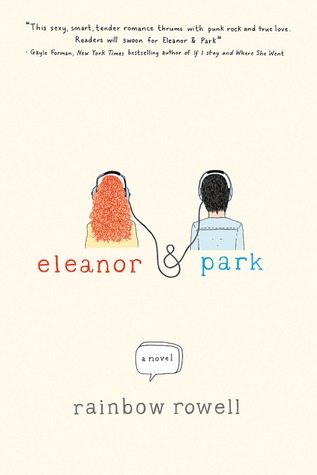
Eleanor and ParkFangirlAttachments


I have recently read the three Rainbow Rowell books currently published and I LOVED them. I am still trying to figure out why.

It all started with Eleanor and Park. It is a YA book that had been getting a lot of buzz lately and being a high school librarian I just had to read it, you know, because it is my job. Yes, I DO have one of the best jobs ever!

I read it over winter break in two days, it would have only taken me one day if I didn't have a husband and kids and the fact that I was at my in-laws and needed to make appearances now and then.  I am still trying to figure out why I liked the book so much. It felt real but it didn't, I connected with the characters but they were not me. I really liked how the characters connected through music but not in a pretentious sort of way. I loved seeing Eleanor and Park's relationship grow.

Next up was Fangirl. I read the book again over two days, staying up until midnight to finish it. This book follows Cath and her twin sister Wren as they navigate thier first year of college. Cath is still wrapped up in a fandom that she loves and writing fanfiction about her beloeved characters. She tries to stay hidden from people and be invisible. Wren on the other hand is living what we see as the typical college life, partying.  Again, why did I like this book so much? Why did I sacrifice some sleep over it? I do not know. I liked the characters and the story was interesting. Even though I find her characters living very different lives than I do they still resonate with me.

Just this week I read Attachments. The premise is kind of strange, this guy named Lincoln is hired by a comany as an IT person and learns later that he has to read flagged email and send warning to people. He is not comfortable with this part of his job but having this job will allow him to move out of his mother's house and hopefully "get a life". One day he started getting flagged email from conversations between Jennifer and Beth and, like us the reader, he becomes intrigued with their conversations and kind of cyber-stalks them and ends up having feelings for one of the women. Somehow, Rowell makes us root for Lincoln and somehow this book has a hopeful ending.

In the end, my quest to find out why I love these books so much is similar to my quest to find out why I like some books over others. Why do I read fiction? What is it I am expecting?

Here are some of my conclusions:

1. Mood is important - There are times when I am just not in the mood for a fantasy book or a teen book or a deep book. Paying attention to what grabs my attention at any given moment significantly affects my opinion of the book. I do not read a lot of realistic fiction (at least not nearly as much as my students do) so when I do finally pick one up I am usually pleasantly surprised. When it comes to fantasy, it just has to be a stellar book because I read more of that genre.

2. I read fiction as an escape. A lot of times I like to imagine myself as one of the characters. Whether they are like me or not, I need to feel a connection with someone in the story.

3. I need a hopeful ending. Not necessarily happy but hopeful.

Not everyone is going to love these books. I can't give them 5 stars because I realize I am a bit biased when it comes to these book. I read them for fun, not to judge and since I had fun reading them then they are awesome books in my humble opinion. She writes deep characters that I can identify with and understand. She writes in a language that I understand. Combine that with an interesting or unique plot and a hopeful ending and you have a book (or books) that I want to keep reading. Rainbow Rowell, you are my new favorite.

4 stars for all three...please don't ask me which one was my favorite!

P.S. Can I just say that I think it is interesting that Eleanor and Park is high school, Fangirl is college, Attachments is about post-college adults (20s) and her new book Landline (July, 2014) is about mid-life. She is currently writing a graphic novel (eek!!!) so I'm guessing it will be middle school? One thing is for sure, I will be reading them all!