Monday, September 9, 2013
Book Review: Conspiracy of Alchemists by Liesel Schwarz
Conspiracy of Alchemists by Liesel Schwarz
Book 1 in The Chonicles of Light and Shadow
LEAVE IT TO CHANCE.
Eleanor “Elle” Chance, that is—a high-flying dirigible pilot with a taste for adventure and the heroine of this edgy new series that transforms elements of urban fantasy, steampunk, and paranormal romance into pure storytelling gold.
It is 1903, and the world is divided between light and shadow. On the side of light is a wondrous science that has transformed everyday life by harnessing magical energies to ingenious new technologies. But each advance of science has come at the expense of shadow—the traditional realm of the supernatural.
Now two ancient powers are preparing to strike back. Blood-sucking immortal Nightwalkers and their spellcasting Alchemist allies have a plan to cover the whole world in shadow. All they require is the sacrifice of a certain young woman whose past conceals a dangerous secret.
But when they come after Elle, they get more than they bargained for. This enterprising young woman, the daughter of a scientific genius, has reserves of bravery and determination that even she scarcely suspects. Now she is about to meet her match in more ways than one: a handsome yet infuriating Warlock named Hugh Marsh, whose agenda is as suspect as his charms are annoyingly irresistible.
Review:
Let it be said that Steampunk and I have a difficult relationship. I really want to love it, I really do. I think it wants to please me and offer me all sorts of things that other genres just don't have: steamships and dirigibles and corsets and fancy gadgets and women actually doing things regularly. But then I realize that, no matter how much steampunk tries to do for me, it's *only* steamships and dirigibles and corsets and gadgets. It's not that there's anything wrong with them, per se, but it becomes hollow. As Ferretbrain once said, "It's an aesthetic looking for a purpose."
So I was pleased to find someone who is trying to pull steampunk into a realm where more fantasy readers are somewhat more comfortable, using magic as well as high-tech steam gadgets to forward a plot and set up a story. There are Warlocks who wield powerful magic and there are Alchemists who forged a dark alliance with Nightwalkers (read: vampires) to gain earthly power.
As almost every steampunk novel does, this one starts with a plucky-and-tough-yet-vulnerable young woman trying to make her way in the world as an airship pilot. Of course she is. But before she can say "goggles," she's pulled into an adventure that's way beyond her. Enter Hugh March, a mysterious man with a mysterious past who does mysterious things for mysterious reason. MYSTERY, dammit!
And of course they are thrown together - two personalities that are not really alike but they start to rub along nicely after a while - and their adventures across Europe and Turkey show them each other's strengths. Also, love. And smoochin'.
The book's real strongsuit lies in the adventure part. When the two main characters are off doing things and shooting down air pirates and exploring Constantinople and doing stuff in Venice, the book is solid.
It's when they start solely interacting with each other that the book starts to be bang-your-head-against-a-wall frustrating. The characters aren't bad, mind you, but Elle has got to be the single most dense and self-deluding Steampunkette ever.
I feel like there was a scene that went something like this:
Hugh: So, you have some special vision powers and the Warlocks want you to use it for them because it will be good for the world.
Elle: Nuh-uh. I don't.
Hugh: Um, you totally do. And if you don't help us, the world will end. Because, you know, Alchemists and stuff.
Elle: I don't have powers, Hugh! If you weren't so dreamy - and if I would just stop having these pesky visions - I could slap you. I'm leaving now.
*Leaves room, has powerful vision.*
Elle: (Upon waking, to self) That Hugh. Such a jerk, saying I have "powers." Doesn't know what he's talking about.
This is me after that scene:
So yeah. About 25% of the book could have been cut out if that conversation had gone something like:
Hugh: You have powers.
Elle: Huh. That explains a lot. What do we do about it?
The worldbuilding is really clever and the story itself is a great adventure. I really enjoyed the combination of fantasy (fairies and vampires) mixed with stereotypical steampunk (advanced-yet-old tech, airships), but I'm not 100% sold on the main character. I wouldn't object to reading the sequel, however, to see where the story goes.
3 out of 5 stars!
A "shining" review
In preparation, or rather anticipation for the upcoming
novel by Stephen King called Doctor Sleep
(September 24, 2013) I decided it was finally time to read The Shining. I have grown up
knowing who Stephen King is. He was a guy who wrote scary, horror stories that
turned into scary, horror movies on T.V. or the big screen that I was not
allowed to watch, yet. I watched the
Stanley Kubrick version of The Shining
in college and was scared out of my mind while my boyfriend was sitting next to
me in awe of Kubrick’s filmmaking abilities. Over the years I have picked up a few of King’s
works like The Stand and part of The Dark Tower series but I never picked
up some of his scarier books.
Earlier this year I heard murmurings that Stephen King was
writing a sequel to The Shining and
was immediately intrigued. What makes an author go back to story after thirty-five
years? Especially, an author who tends to only write stand-alone novels? Since I
drive a lot for work, I decided to listen to The Shining and I was not disappointed. First of all, the story was
written very well. We do not only get the perspective of one character, but all
four of the main characters. I really liked this change in perspective because
each character had a story to tell and all of their voices were necessary to
complete the picture.
We see young Danny Torrence who is trying to understand the
thoughts he hears from others, most notably his parents and make sense of the
world, which is hard for any five year old. We hear Wendy’s inner thoughts
about her controlling mother, her fears about her son and her jealously over
her husband and son’s close relationship. Jack Torrence, the man who eventually
gets consumed by the hotel, is one of the most tragic characters I have read. We
learn about growing up in a household with an abusive father, his struggle with
alcoholism and every other event that led him to take this caretaker job. You
are angry at him but also sympathetic. We even get the inner thoughts of Dick Halloran,
the Overlook’s Chef, who “sees” Danny right away and explains “the shine” to
him. All of the feelings of these characters
are explained in such a realistic way that these are not just characters in a
book they are people you know or perhaps thoughts you have had yourself.
I listened to this story on audiobook instead of reading it
and Campbell Scott did a superb job. He did not make a lot of changes in his
voice when speaking when changing characters but when the hotel starts to get a
hold of Jack you can hear it. The good
thing about listening to the story is that you do not miss a detail. The book
is a little over-descriptive at times and some of the inner monologues become a
little repetitive but overall the flow of the story worked well and transferred
to audio format successfully.
I decided to watch the movie again as I was reading the book
and the contrasts were startling. My boyfriend from college turned into my
husband and he was still amazed at the cinematography. We both loved how the
camera just followed little Danny and his tricycle (power-wheels!) around and
around the hotel. I was of course, still scared out of my mind and angry at the
many changed Kubrick made. There is no slow change that comes over Jack, he
looks crazed from the beginning. At the beginning of the novel the family of
three seems to have fun. They go to town a few times and during the first snow
they sled together. There are random strange incidents that happen to give a
sense of foreboding and you get the feeling that each family member is wary of
their surroundings and has a bad feeling about the place but with nowhere else
to go they are stuck, until literally they are stuck under feet of snow. In the
movie, Jack Nicholson did a great job
and that look in one of the early scenes he gives his wife and child outside
playing in the snow will haunt my nightmares for a long time. But he seems
condescending and snide with his wife and child from the start and it is no surprise
that he goes crazy and tries to kill them after a few months with them. There could be a book written on the
differences so I won’t go further but the change in the character of Jack was
one of the biggest disappointments for me.
I cannot wait to read Doctor Sleep. If I can wait long
enough and if Campbell Scott will read it to me I might wait for the audiobook.
For such a terrifying book, I think I will need listen to it in the
daytime, with the light shining down on me.
Rating 5/5 stars
Tuesday, September 3, 2013
Top Ten Tuesday: Books You Wish Were Taught in Schools
Top Ten Tuesday is a weekly meme hosted by The Broke and the Bookish.
There are some books that stick with you for the adventure they take you. There are books whose main characters become you imaginary best friend or book crush. There are books that make you cry or make you angry. However they get to you, if they make you read, I'm all for it.
I would rather someone read awful crap than not read anything at all. Of course, in a perfect world, students would read amazing books instead, and get a terrific book addiction and then the world would be populated with more readers no child anywhere would ever have to hear, as I did: "Why don't you get a life instead of reading all the time?"
Books that Make Reading Fun
1. The Last Unicorn by Peter S Beagle.
"The unicorn lived in a lilac wood and she lived all alone." This is the most perfect opening sentence to one of the most beautifully written books I've ever read. Boys - have no fear! She might be a unicorn but her adventures are filled with anything but rainbows. There are harpies and witches and demon bulls and talking skeletons and a cursed castle. As a bonus, it's a deeper book than it seems on the surface, including lovely passages about responsibility, fate, and immortality.
2. Lamb by Christopher Moore
By all rights, the religious right could have taken arms up against this book, but it seems the reading public took it for the lighthearted joke it was intended to be and have been keeping it in print for years. There's even a special edition that looks like a Bible. There are so many jokes and puns it's hard to keep track of them all. Basically, it's Life of Brian except it is really about Jesus. There just isn't enough satire in school curricula.
3. Ender's Game by Orson Scott Card
I'm sure there are kids who would read this for fun anyway - or who already have. Why not discuss some of the other things in it, like the morality of what the adults are doing, the dubious benefits of waging war, the global population issues, guilt vs innocence. Yes, it's a story about games, aliens, and spaceships, but it's also about a lot more.
Books with Female Protagonists that Boys Will Root For, Too
5. Graceling by Kristin Cashore
You knew this was going on the list, right? I think this is an important evolution in YA literature simply because of the way the female protagonist interacts with other women and because of the way that the male lead responds to her (superior) prowess - with respect instead of intimidation. There is a rather pervasive yet not ham-handed feminism throughout the story, and no one should object to the ideas Cashore presents.
6. Bloody Jack by L. A. Meyer
Sometimes you want to smack Jack (aka Mary Faber) around for making ridiculous decisions and then having to face the consequences, but in this first book, it's all about the Age of Sail and the domination of the British Empire. There's a healthy dose of history here served up alongside all the hijinks. The series goes on for (at this time) eleven books, giving readers more and more stories to devour.
7. A Northern Light by Jennifer Donnelly
Along with the protagonist who needs to get out of her backwater home, there is a murder mystery going on based on An American Tragedy by Dreiser. A books about a book about a real murder. Excellent.
And finally, the "Precautionary Tale"Book
8. Twilight by Stephenie Meyer.
Love it or hate it, I feel like young women (and probably the young men, too) should be forced to read this series with a counselor who can explain why this is not romantic, and if your S.O. ever does anything like this in real life, you are probably in an abusive relationship.
Confession: Labor Day has thrown me for a loop and I almost forgot to post something today. Whoops!
There are some books that stick with you for the adventure they take you. There are books whose main characters become you imaginary best friend or book crush. There are books that make you cry or make you angry. However they get to you, if they make you read, I'm all for it.
I would rather someone read awful crap than not read anything at all. Of course, in a perfect world, students would read amazing books instead, and get a terrific book addiction and then the world would be populated with more readers no child anywhere would ever have to hear, as I did: "Why don't you get a life instead of reading all the time?"
Books that Make Reading Fun
1. The Last Unicorn by Peter S Beagle.
"The unicorn lived in a lilac wood and she lived all alone." This is the most perfect opening sentence to one of the most beautifully written books I've ever read. Boys - have no fear! She might be a unicorn but her adventures are filled with anything but rainbows. There are harpies and witches and demon bulls and talking skeletons and a cursed castle. As a bonus, it's a deeper book than it seems on the surface, including lovely passages about responsibility, fate, and immortality.
2. Lamb by Christopher Moore
By all rights, the religious right could have taken arms up against this book, but it seems the reading public took it for the lighthearted joke it was intended to be and have been keeping it in print for years. There's even a special edition that looks like a Bible. There are so many jokes and puns it's hard to keep track of them all. Basically, it's Life of Brian except it is really about Jesus. There just isn't enough satire in school curricula.
3. Ender's Game by Orson Scott Card
I'm sure there are kids who would read this for fun anyway - or who already have. Why not discuss some of the other things in it, like the morality of what the adults are doing, the dubious benefits of waging war, the global population issues, guilt vs innocence. Yes, it's a story about games, aliens, and spaceships, but it's also about a lot more.
Books with Female Protagonists that Boys Will Root For, Too
5. Graceling by Kristin Cashore
You knew this was going on the list, right? I think this is an important evolution in YA literature simply because of the way the female protagonist interacts with other women and because of the way that the male lead responds to her (superior) prowess - with respect instead of intimidation. There is a rather pervasive yet not ham-handed feminism throughout the story, and no one should object to the ideas Cashore presents.
6. Bloody Jack by L. A. Meyer
Sometimes you want to smack Jack (aka Mary Faber) around for making ridiculous decisions and then having to face the consequences, but in this first book, it's all about the Age of Sail and the domination of the British Empire. There's a healthy dose of history here served up alongside all the hijinks. The series goes on for (at this time) eleven books, giving readers more and more stories to devour.
7. A Northern Light by Jennifer Donnelly
Along with the protagonist who needs to get out of her backwater home, there is a murder mystery going on based on An American Tragedy by Dreiser. A books about a book about a real murder. Excellent.
And finally, the "Precautionary Tale"Book
8. Twilight by Stephenie Meyer.
Love it or hate it, I feel like young women (and probably the young men, too) should be forced to read this series with a counselor who can explain why this is not romantic, and if your S.O. ever does anything like this in real life, you are probably in an abusive relationship.
Confession: Labor Day has thrown me for a loop and I almost forgot to post something today. Whoops!
Thursday, August 29, 2013
Battle of the Books (2): The Secret History vs Theodora
For those of you new to my Battle of the Books, I read two books of similar story, setting and/or genre and pit them against one another. I base my judgements on the following criteria:
1. Main Character
2. Supporting Cast
3. Worldbuilding
4. Pacing
5. Plot Development
6. Plot Resolution
7. Style/Use of Language
8. Cover Art (Tiebreaker only)
Today's Byzantine Book Battle pits A Secret History by Stephanie Thornton against Theodora: Accress, Empress, Whore by Stella Duffy.
This match-up was a bit more challenging than I expected. For some silly reason, I assumed that it would be far easier to draw comparisons when the story was with the exact same character and exact same storyline. Instead, this makes it somewhat harder: with the plot taking the (more or less) exact same trajectory, and using (more or less) the same cast, you have to rely on nitpicking to draw the lines.
1. Main Character - Thornton
Here is one huge difference right off the bat. A Secret History is told in the first person, using Theodora's own voice. Duffy's Theodora is told the in third person. By using the first person, you get a clearer view of Theodora, seeing her as more impatient, impetuous and sassy. Thornton also uses dialogue to better effect, giving a clearer characterization and letting the characters be the IN and a part of the world, rather than just occupying it. Both authors, though, do a fine job of giving Theodora a spine and a great deal of resilience.
2. Supporting cast -Thornton
Thornton, again, delivers with her dialogue. By living in T's head and using more dialogue than description, the reader is given a clearer picture of the people around her. Not all supporting characters are given the same amount of screen time, of course, but the few that are seem better fleshed out.
3. Worldbuilding - Duffy
Duffy, hands down. Whereas Thornton's dialogue gives better opportunities to illuminate the personalities of the characters, Duffy's third person prose allows for better description of the age and the area. For readers completely unfamiliar with the time period, Duffy gives a wider canvas on which to paint the story. The politics, religion and culture of the time are far more clear in Duffy's version of the story.
4. Pacing - Thornton
Thornton covers all of Theodora's life in one 450-page novel. Duffy's story goes from childhood through her being crowned Empress. (There is a second book, The Purple Shroud, that covers the rest of her life.) Not that covering a life at a leisurely pace is wrong, but I prefer Thornton's complete story in one volume. There are enough series out there.
5. Plot Development -Duffy
(Possible Spoilers)
Toward the end of Thornton's story, there is a bit of a melodrama about Theodora's son, and it felt shoehorned in and awkward, as if the author was grasping for something amazing to happen to the protagonist, since her meteoric rise and ongoing challenges and victories weren't enough. Duffy's story felt more plausible, and more like the author kept with the known sources for the root of her plot line(s).
6. Plot Resolution - Thornton
As previously stated, Thornton's A Secret History covers a woman's entire life. The story is wrapped up in the most logical and inevitable way there is. Duffy's Theodora stops just at the climax of our heroine's social climb. You can pick up the second book, but do you want to?
7. Style/Use of Language - Thornton
Duffy really likes commas. A lot. I am not opposed to long sentences, but it's not uncommon to see one sentence that goes on four or five printed lines in the text. If I were listening to an audiobook, it might not make a difference. It does make a difference when reading a printed copy, and I had to reread a single sentence to get the meaning.
Final Score:
Thornton: 5
Duffy: 2
As another reviewer friend has stated for me, Thornton's book read a lot like Kate Quinn's novels. If you like her style (and I really, really do), then Thornton is the clear favorite.
HOWEVER, if you like your books more descriptive and heavier on paragraphs than on spoken dialogue, you'll probably prefer Duffy's depiction of the Byzantine empress.
If you have an idea for another Battle of the Books match-up, post your suggestions in the comments!
1. Main Character
2. Supporting Cast
3. Worldbuilding
4. Pacing
5. Plot Development
6. Plot Resolution
7. Style/Use of Language
8. Cover Art (Tiebreaker only)
Today's Byzantine Book Battle pits A Secret History by Stephanie Thornton against Theodora: Accress, Empress, Whore by Stella Duffy.
This match-up was a bit more challenging than I expected. For some silly reason, I assumed that it would be far easier to draw comparisons when the story was with the exact same character and exact same storyline. Instead, this makes it somewhat harder: with the plot taking the (more or less) exact same trajectory, and using (more or less) the same cast, you have to rely on nitpicking to draw the lines.
1. Main Character - Thornton
Here is one huge difference right off the bat. A Secret History is told in the first person, using Theodora's own voice. Duffy's Theodora is told the in third person. By using the first person, you get a clearer view of Theodora, seeing her as more impatient, impetuous and sassy. Thornton also uses dialogue to better effect, giving a clearer characterization and letting the characters be the IN and a part of the world, rather than just occupying it. Both authors, though, do a fine job of giving Theodora a spine and a great deal of resilience.
2. Supporting cast -Thornton
Thornton, again, delivers with her dialogue. By living in T's head and using more dialogue than description, the reader is given a clearer picture of the people around her. Not all supporting characters are given the same amount of screen time, of course, but the few that are seem better fleshed out.
3. Worldbuilding - Duffy
Duffy, hands down. Whereas Thornton's dialogue gives better opportunities to illuminate the personalities of the characters, Duffy's third person prose allows for better description of the age and the area. For readers completely unfamiliar with the time period, Duffy gives a wider canvas on which to paint the story. The politics, religion and culture of the time are far more clear in Duffy's version of the story.
4. Pacing - Thornton
Thornton covers all of Theodora's life in one 450-page novel. Duffy's story goes from childhood through her being crowned Empress. (There is a second book, The Purple Shroud, that covers the rest of her life.) Not that covering a life at a leisurely pace is wrong, but I prefer Thornton's complete story in one volume. There are enough series out there.
5. Plot Development -Duffy
(Possible Spoilers)
Toward the end of Thornton's story, there is a bit of a melodrama about Theodora's son, and it felt shoehorned in and awkward, as if the author was grasping for something amazing to happen to the protagonist, since her meteoric rise and ongoing challenges and victories weren't enough. Duffy's story felt more plausible, and more like the author kept with the known sources for the root of her plot line(s).
6. Plot Resolution - Thornton
As previously stated, Thornton's A Secret History covers a woman's entire life. The story is wrapped up in the most logical and inevitable way there is. Duffy's Theodora stops just at the climax of our heroine's social climb. You can pick up the second book, but do you want to?
7. Style/Use of Language - Thornton
Duffy really likes commas. A lot. I am not opposed to long sentences, but it's not uncommon to see one sentence that goes on four or five printed lines in the text. If I were listening to an audiobook, it might not make a difference. It does make a difference when reading a printed copy, and I had to reread a single sentence to get the meaning.
Final Score:
Thornton: 5
Duffy: 2
As another reviewer friend has stated for me, Thornton's book read a lot like Kate Quinn's novels. If you like her style (and I really, really do), then Thornton is the clear favorite.
HOWEVER, if you like your books more descriptive and heavier on paragraphs than on spoken dialogue, you'll probably prefer Duffy's depiction of the Byzantine empress.
If you have an idea for another Battle of the Books match-up, post your suggestions in the comments!
Tuesday, August 27, 2013
Top Ten Tuesday - Memorable Secondary Characters
Top Ten Tuesday is a weekly meme hosted by The Broke and the Bookish.
Of course, I'm a horrible lazy person and don't post weekly, which rather defeats the purpose.
This week's subject is "Top Ten Memorable Secondary Characters."
I have chosen to define "secondary" characters as "neither the protagonist(s) nor the antagonist(s)" because otherwise I don't know what to do with myself.
In no particular order:
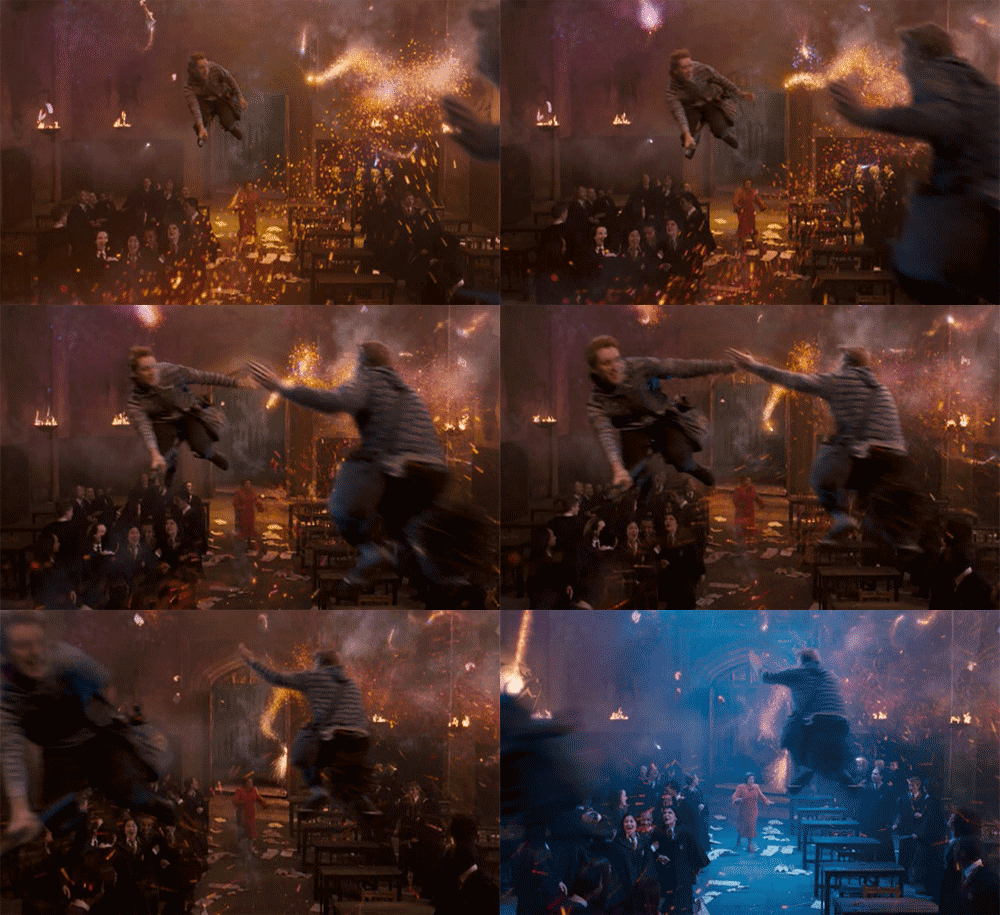
1. The Weasley Twins from the Harry Potter series
They earn a place on this list just for their no-holds-barred, over-the-top exit from Hogwarts.
2. The Dragon from Voyage of the Basset.
This is one of my favorite books, hands-down. I almost cried with joy when I found a copy at a bookstore. The dragon marks a pivotal turning point in the story and has so many words of wisdom. There are other great characters and creatures in this story, but the dragon is the one that sticks with me.
3. Ginger from Black Beauty
Poor, poor Ginger. If you haven't read Black Beauty, you're missing out on a good falcon punch to feels.
4. Iron Horse from the Iron Fey series
Iron Horse gets on the list because, of all the cleverly crafted fey creatures Kagawa created for her series, he's the only one whose name I actually remember. Also, because his name is a pun. He's clearly named after railroad technology, but he's also a giant horse made of iron - when he wants to be. And that's friggin' sweet.
5. Brimstone from Daughter of Smoke and Bone
At first Brimstone set off my Sketchiness Alarm in a major way. What was he hiding from Karou? Why in the name of corn is he doing with all those teeth? When his purpose is revealed and the "magic" of the chimaera is explained I think my jaw dropped into my lap. SO CLEVER. Read this book. Read it right now.
6. Faithful (in all his incarnations) from the Tortall books by Tamora Pierce
I always knew that if cats could speak, they would be sarcastic. He's there for Alanna - and for other Tortall heroines, when they need him. And he's a black cat with purple eyes. I want one.
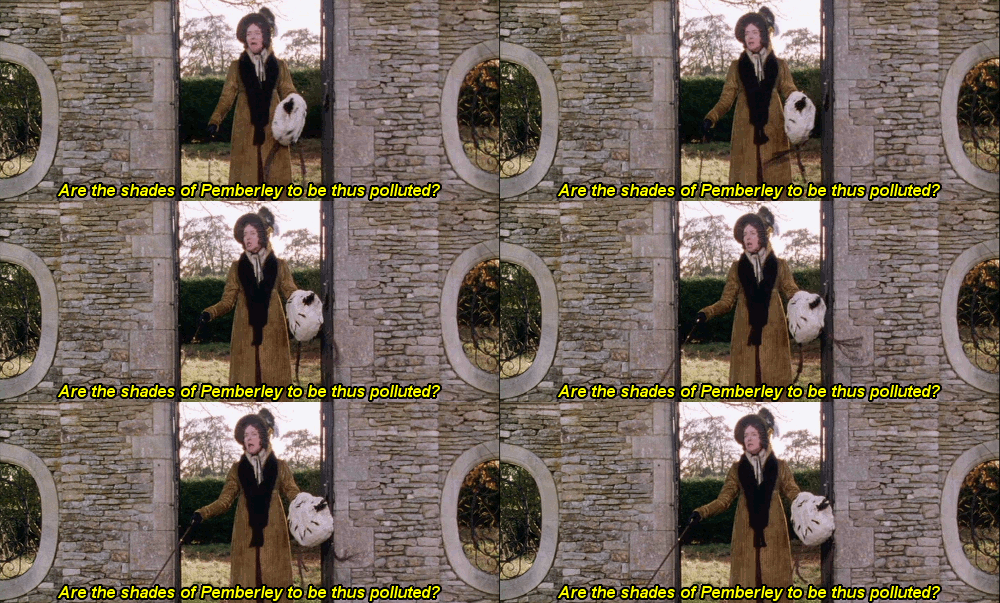
7. Lady Catherine de Bourgh from Pride and Prejudice
This woman! I love every scene she's in, from explaining her "natural taste" in music (she doesn't play) to giving everyone unwanted advice to the pivotal scene in which she makes a complete butthead of herself. She has all of Lady Violet's pride with non of her cunning or self-awareness.
8. The other half-dragons from Seraphina
I couldn't pick just one. By their existence, they open a new world for our heroine. Each of them has gotten by in their lives, overcoming difficulties and prejudice to find their place in the world. This gives the reader hope for Seraphina - and makes her the center of a smaller world in which she doesn't have to hide everything about herself.
9. Lady Silence from The Terror
This book gave me the chills AND the heeby-jeebies. At the same time. Of all the characters in the story, Lady Silence - the mysterious Eskimo woman who's missing her entire tongue - is the one that stands out to me. What happened to her? What does she want? What secrets is she hiding? Why is she hanging out around two doomed and stranded ships in the middle of the Arctic? Just thinking about it makes me want to read this book again, and be creeped out all over again.
10. Falcor from The Neverending Story
Tell me you didn't want your very own luck dragon after reading this book (or watching the movie and THEN reading the book). Because then I know you will be a liar. Not only can he fly without wings, but he's supportive and helpful.
And that's all for today.
I'm sure there are many, many more I've forgotten.
Of course, I'm a horrible lazy person and don't post weekly, which rather defeats the purpose.
This week's subject is "Top Ten Memorable Secondary Characters."
I have chosen to define "secondary" characters as "neither the protagonist(s) nor the antagonist(s)" because otherwise I don't know what to do with myself.
In no particular order:
1. The Weasley Twins from the Harry Potter series
They earn a place on this list just for their no-holds-barred, over-the-top exit from Hogwarts.
2. The Dragon from Voyage of the Basset.
This is one of my favorite books, hands-down. I almost cried with joy when I found a copy at a bookstore. The dragon marks a pivotal turning point in the story and has so many words of wisdom. There are other great characters and creatures in this story, but the dragon is the one that sticks with me.
3. Ginger from Black Beauty
Poor, poor Ginger. If you haven't read Black Beauty, you're missing out on a good falcon punch to feels.
4. Iron Horse from the Iron Fey series
Iron Horse gets on the list because, of all the cleverly crafted fey creatures Kagawa created for her series, he's the only one whose name I actually remember. Also, because his name is a pun. He's clearly named after railroad technology, but he's also a giant horse made of iron - when he wants to be. And that's friggin' sweet.
5. Brimstone from Daughter of Smoke and Bone
At first Brimstone set off my Sketchiness Alarm in a major way. What was he hiding from Karou? Why in the name of corn is he doing with all those teeth? When his purpose is revealed and the "magic" of the chimaera is explained I think my jaw dropped into my lap. SO CLEVER. Read this book. Read it right now.
6. Faithful (in all his incarnations) from the Tortall books by Tamora Pierce
I always knew that if cats could speak, they would be sarcastic. He's there for Alanna - and for other Tortall heroines, when they need him. And he's a black cat with purple eyes. I want one.
7. Lady Catherine de Bourgh from Pride and Prejudice
This woman! I love every scene she's in, from explaining her "natural taste" in music (she doesn't play) to giving everyone unwanted advice to the pivotal scene in which she makes a complete butthead of herself. She has all of Lady Violet's pride with non of her cunning or self-awareness.
8. The other half-dragons from Seraphina
I couldn't pick just one. By their existence, they open a new world for our heroine. Each of them has gotten by in their lives, overcoming difficulties and prejudice to find their place in the world. This gives the reader hope for Seraphina - and makes her the center of a smaller world in which she doesn't have to hide everything about herself.
9. Lady Silence from The Terror
This book gave me the chills AND the heeby-jeebies. At the same time. Of all the characters in the story, Lady Silence - the mysterious Eskimo woman who's missing her entire tongue - is the one that stands out to me. What happened to her? What does she want? What secrets is she hiding? Why is she hanging out around two doomed and stranded ships in the middle of the Arctic? Just thinking about it makes me want to read this book again, and be creeped out all over again.
10. Falcor from The Neverending Story
Tell me you didn't want your very own luck dragon after reading this book (or watching the movie and THEN reading the book). Because then I know you will be a liar. Not only can he fly without wings, but he's supportive and helpful.
And that's all for today.
I'm sure there are many, many more I've forgotten.
Saturday, August 24, 2013
Book Review: Cuckoo's Calling by JK Rowling
Cuckoo's Calling by Robert Galbraith (aka JK Rowling)
Series: Cormoran Strike, Book 1
After losing his leg to a land mine in Afghanistan, Cormoran Strike is barely scraping by as a private investigator. Strike is down to one client, and creditors are calling. He has also just broken up with his longtime girlfriend and is living in his office.
Then John Bristow walks through his door with an amazing story: His sister, thelegendary supermodel Lula Landry, known to her friends as the Cuckoo, famously fell to her death a few months earlier. The police ruled it a suicide, but John refuses to believe that. The case plunges Strike into the world of multimillionaire beauties, rock-star boyfriends, and desperate designers, and it introduces him to every variety of pleasure, enticement, seduction, and delusion known to man.
Review:
Normally I let a book stew in my mind for a while before I write a review, but I don't know if that is going to help me out with this one. I have to confess that mystery is generally not my genre of choice, but my coworker told me that this book had a terrific ending and that it was worth a read anyway. So here I am.
As the blurb says, this is about a down-on-his-luck detective trying to solve a case about a world-famous supermodel whose death was ruled a suicide. As with many series' initial books, there are a lot of moving parts to this story: there's the relationship with Strike and his family and his past, his growing friendship with his new secretary Robin, his finances, his injury - and of course there's the whole part of the book about a potentially murderer supermodel, who had a fine slew of her own problems.
At 455 pages (US Hardcover) this is not a "light reading" sort of book. With all the moving pieces and web of characters zipping in and out of the narrative, you have to pay close attention. Strike interviews character after character, his clever secretary using her wiles to track them down one by one, and there is always the impression that something increasingly important is being revealed with every scene. Something is being revealed with every interview or conversation, no matter how unreliable or biased the character seems to be, and of course the author/Strike doesn't reveal which details are the important ones, since that's pretty much what makes a mystery interesting.
As the book goes along, the stakes rise (as they should with any fiction story), and the characters introduced and details revealed become more and more engaging. But, still, right up until the Big Reveal, I was pretty much at a loss for what was about to happen.
Did the ending surprise me? Yes, yes it did. Did I have a clue who the real murderer was? No, no I did not. In that respect, I suppose this book was fairly well done.
And that's the problem I have with the mystery genre. The book is only considered "good" if the reader has no idea what's really going on as they get into the final passages of the book. If done correctly, everything makes complete sense in retrospect. And that, in return makes me feel like a drooling moron as I'm reading a mystery. (This is because, as my husband tells me, I am doing it wrong. Apparently that's not "how you read a mystery." I was unaware, until last night, that one is capable of reading an entire genre wrong.)
Apparently you're supposed to enjoy the setup and the suspense and maybe take a few stabs at figuring it out - but I don't have the patience for that. When I pick a HF, I enjoy reading the historical context and seeing the characters move through real historical events. If the characters are well-written, I know exactly why they are doing what they are doing and the importance of their actions (or unimportance, depending on the period and character). When I'm reading a fantasy and the protagonist is trying to accomplish their goal, I completely understand what they're looking for and why.
Mystery takes all of that and says "Nuh-uh, honey. You wanna know? Well, tough beans. Read the last twenty pages if you want cheat like a dirty cheater, but you're only cheating yourself. Now sit down and shut up."
So yeah.
Cuckoo's Calling. How about I get back to that?
A lot of people picked it up because Rowling wrote it. I wasn't going to touch it (see "Issues with the genre," above) but I read it anyway. There are a few writing tics that become increasingly irritating once you notice them. It's like someone popping their gum or chewing really loudly: if you don't even notice it, it's not a problem. But once you DO notice it, then it's all you can hear and it makes you want to punch the person. No? Just me?
First, for almost every character, we get a heavy-handed description of what they look like the second they enter a scene. This isn't the worst thing ever, but cumbersome homemade metaphor spring up in the work like weeds and draw the attention from the story and into the heavy use of language. Next, "show don't tell" is a rule that I'm not a stickler for, but once you notice that many situations are accompanied by an explanation why that person is here and what they are doing and how that matters, instead of just letting the reader figure it out - it becomes more "literary loud chewing" and that's all I could notice.
If you like mysteries in general, I suppose this one is just as good as any of them. The ending took me completely off-guard, and in retrospect, all of the little clues made complete sense. But that doesn't change the fact that for most of the book, I felt like an idiot.
3.5/5 Stars - Well executed, clever reveals, decent characterization. Did not change my disinterest in the mystery genre.
Thursday, August 22, 2013
Book Review: The Serpent and the Pearl
Title: The Serpent and the Pearl
Author: Kate Quinn
Published: August 6, 2013
Rome, 1492. The Holy City is drenched with blood and teeming with secrets. A pope lies dying and the throne of God is left vacant, a prize awarded only to the most virtuous--or the most ruthless. The Borgia family begins its legendary rise, chronicled by an innocent girl who finds herself drawn into their dangerous web...
Vivacious Giulia Farnese has floor-length golden hair and the world at her feet: beauty, wealth, and a handsome young husband. But she is stunned to discover that her glittering marriage is a sham, and she is to be given as a concubine to the ruthless, charismatic Cardinal Borgia: Spaniard, sensualist, candidate for Pope--and passionately in love with her.
Two trusted companions will follow her into the Pope's shadowy harem: Leonello, a cynical bodyguard bent on bloody revenge against a mysterious killer, and Carmelina, a fiery cook with a past full of secrets. But as corruption thickens in the Vatican and the enemies begin to circle, Giulia and her friends will need all their wits to survive in the world of the Borgias.
Review:
For reasons I can't entirely explain, I am a bit of a Kate Quinn fangirl. There's something about her particular writing style that has rekindled my flagging interesting in reading not once or twice, but FOUR times. The women is batting a thousand, people. That's worth a gold star right there. This might cloud my judgement on her books.
This is Quinn's first stab at a time period outside the Roman Empire. That didn't stop her from choosing interesting protagonists, just like she always does. Giulia Farnese is an idealistic young woman who finds her beliefs and character challenged when she finds out that her marriage was arranged for the benefit of another man. Carmelina is on the run from Venice, hiding a bundle of recipes, a stolen relic and pile of secrets. Using her skills as a cook and more than a little bravado, she works her way into the households of the powerful in Rome. Last, Leonello is a sharp-tongued dwarf who would rather stab you than juggle for your amusement and is out to avenge his murdered friend.
There's something about her character choices that make the story interesting right away. Choosing two female protagonists in a time when they didn't possess any real power, and a dwarf when they were considered amusement for the wealthy, means that the narrative shows these three very different people trying to work alongside one another while finding their place in an uncertain world.
As the story progresses, each of the characters find their own strengths, learning to see (and use) the world as it is, rather than how it might be. Pragmatism rules the day as Giulia trades her respectability for a reputation that opens some doors while slamming others - and she finds how that can be a freedom and power on its own. Carmelina begins to take ownership of her fate while Leonello starts to smooth his edges and starts making inroads into the murderer's identity.
And something really dramatic happens - and the book is over. And I'm left saying "No no no! There has to be more!" And there is. It's the second book of the series, due to be released in January of 2014.
So, I'm going to deduct part of a star for that dirty, dirty trick, and still say I really love Kate Quinn. I will absolutely be purchasing The Lion and the Rose when it hits shelves.
4.5 out of 5 stars!
Subscribe to:
Posts (Atom)